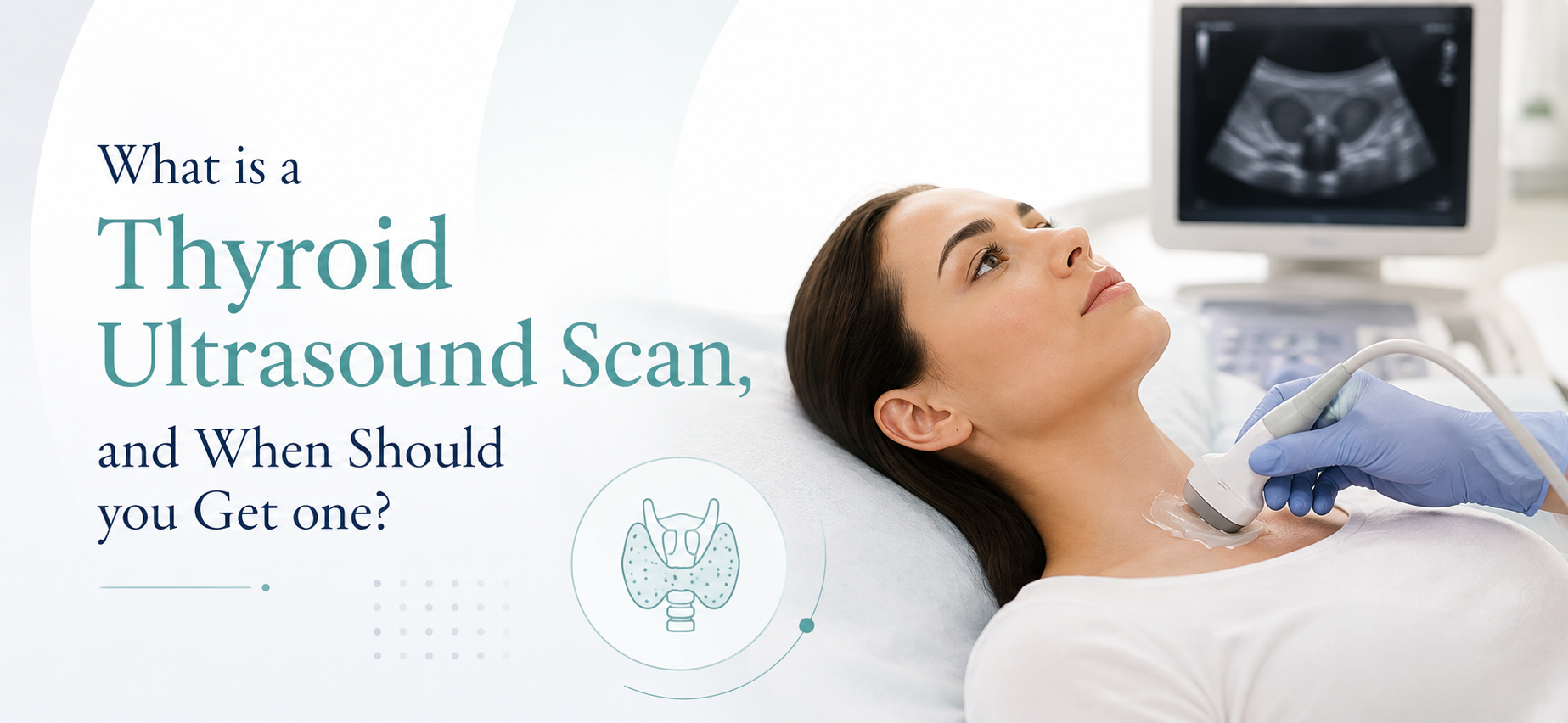
The thyroid is a small, butterfly-shaped gland in the front of your neck, but it has a big job.
It has different hats to fill, such as regulating your metabolism, energy, temperature, and even your mood.
But when something feels off (let’s say you notice a lump, your neck looks fuller than usual, or your blood tests come back with unexpected thyroid results), it makes sense to want clear answers on these.
In such cases, one of the first tests your GP may suggest, or one that you should be looking at, is a thyroid ultrasound scan.
It’s a safe, painless way to look closely at the thyroid and the surrounding area using sound waves, not radiation.
In this guide, we’ll walk through what the scan actually involves, what your results might mean, how ultrasound compares with other thyroid tests, and where it fits into a wider thyroid health check.
Along the way, you’ll see options for booking a thyroid ultrasound or a more complete thyroid health assessment in London.
What is a thyroid ultrasound scan?
A thyroid ultrasound uses a small handheld probe and a layer of gel on the skin over your neck to show detailed images of your thyroid on a screen. It helps your clinician see:
- The size and shape of your thyroid
- Whether there are any nodules (lumps) or cysts
- Whether the gland looks enlarged (goitre) or has a changed texture
- Nearby structures, such as certain lymph nodes in your neck
You might be sent for a thyroid ultrasound if:
- You’ve noticed a lump or swelling in your neck
- Your doctor has felt that your thyroid is enlarged
- Your thyroid blood tests suggest an overactive or underactive thyroid
- You’ve had thyroid surgery or known thyroid nodules in the past
- There’s a family history of thyroid problems or thyroid cancer
Because it’s quick, non-invasive and widely available, thyroid ultrasound has become the standard first imaging test for many thyroid concerns.
Thyroid ultrasound vs “thyroid scan”: what is the difference?
If you’ve been told you need a “thyroid scan”, it’s easy to wonder whether that means ultrasound, something radioactive, or a CT. The word “scan” gets used for several different tests.
Here’s a simple way to separate them:
| Test | What it is | What it shows best | Uses radiation? | Typical use case |
|---|---|---|---|---|
| Thyroid ultrasound | Probe and gel on the neck using sound waves | Structure: size, nodules, cysts, texture, blood flow | No | First-line imaging for lumps, nodules, goitre |
| Nuclear medicine thyroid scan | Small amount of radioactive tracer; camera measures uptake | Function: how active thyroid tissue is | Yes | Distinguishing overactive (“hot”) vs underactive (“cold”) areas |
| CT/MRI of the neck | Cross-sectional imaging of the neck and upper chest | Deeper structures, complex masses, retrosternal goitre | CT uses radiation, MRI does not | Used when ultrasound is limited or deeper extension is suspected |
In everyday terms: ultrasound is the “picture” of what the gland looks like. Nuclear medicine scans are more like a “map” of how active different parts of the gland are.
On the other hand, CT and MRI come into play in more complex cases. For most people with a thyroid lump or suspected nodule, ultrasound is the starting point.
How to prepare for a thyroid ultrasound scan
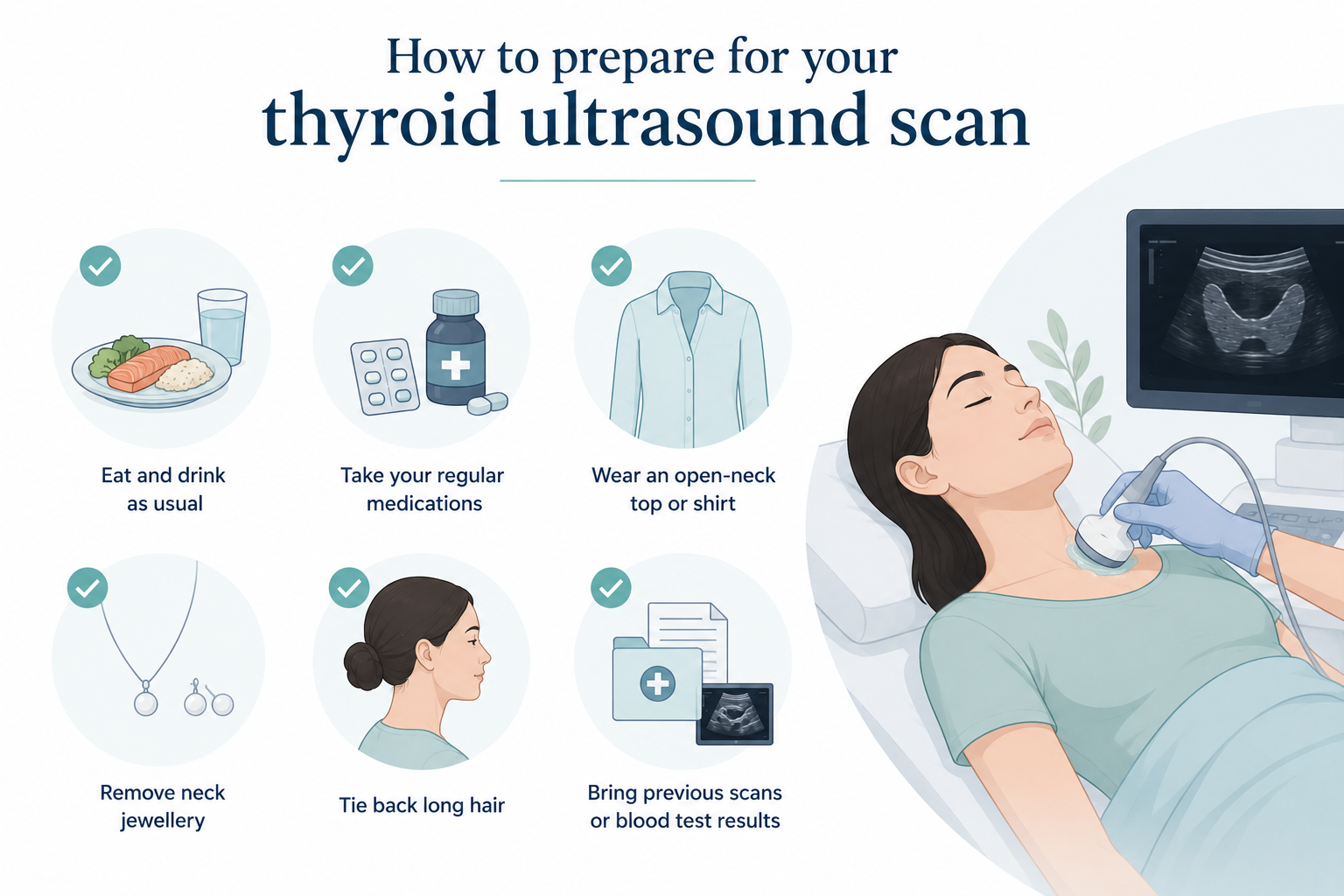
It’s normal to want to know your preparation before you go for any ultrasound scan. The good news is that with a thyroid ultrasound scan, there is no complicated prep list. It is one of the simplest tests to get ready for.
In most cases, you can eat and drink as usual on the day of your scan, and you don’t need to stop your regular medications just for the ultrasound. There’s no fasting and no injections or contrast dye involved. What helps most is wearing something that makes the neck easy to access.
An open-neck top or a shirt that can be gently lowered at the collar is ideal, and neck jewellery is best removed beforehand so it doesn’t get in the way. If you have long hair, tying it back can make it easier for the sonographer to see and move the probe.
If you have previous thyroid scans or blood test results, bringing them along is very useful. They give the clinician a clearer sense of your thyroid history and help them see whether anything has changed over time.
What happens during the ultrasound scan?
Here is a quick overview of what really happens on your scan day:
First, you’ll be asked to lie on your back on the examination couch. A small pillow or cushion may be placed under your shoulders so your neck is gently tilted back. This position helps bring the thyroid into view and makes the scan easier to perform.
Next comes the gel. The clinician applies a thin layer of clear, water-based gel to the skin over the front of your neck. It might feel a little cool, but it shouldn’t be uncomfortable. The gel helps the ultrasound probe make good contact with your skin so the images are clearer.
The scanning itself involves the probe being moved slowly across your neck in different directions. Both lobes of the thyroid and the central part (the isthmus) are carefully examined.
Depending on why you were referred, nearby lymph nodes and other neck structures may also be scanned. Throughout the process, the clinician will take measurements and save images for the report. In some cases, they may turn on colour Doppler, which shows blood flow in and around the gland in real time.
For most people, a focused thyroid and neck ultrasound takes around 15–30 minutes. If there are several nodules or more areas to assess, it may take a little longer. You can breathe and swallow normally throughout. You might feel some gentle pressure from the probe, but the test itself is painless and does not use radiation.
What your thyroid ultrasound can show
What a normal thyroid looks like on ultrasound
On ultrasound, a normal thyroid usually appears as a smooth-outlined gland with a fairly even texture. The report may say that the size and volume are within expected ranges and that there are no discrete nodules.
If everything looks normal, that information can be reassuring. It suggests that your symptoms are unlikely to be due to structural thyroid problems, and your doctor may focus more on blood tests or other possible causes.
Common findings: nodules, cysts and goitre
Once you look for something, you often find more of it. That’s very true with thyroid nodules. Many people have small nodules and only discover them when they have a scan. The key is understanding what the scan is actually saying.
Typical findings include:
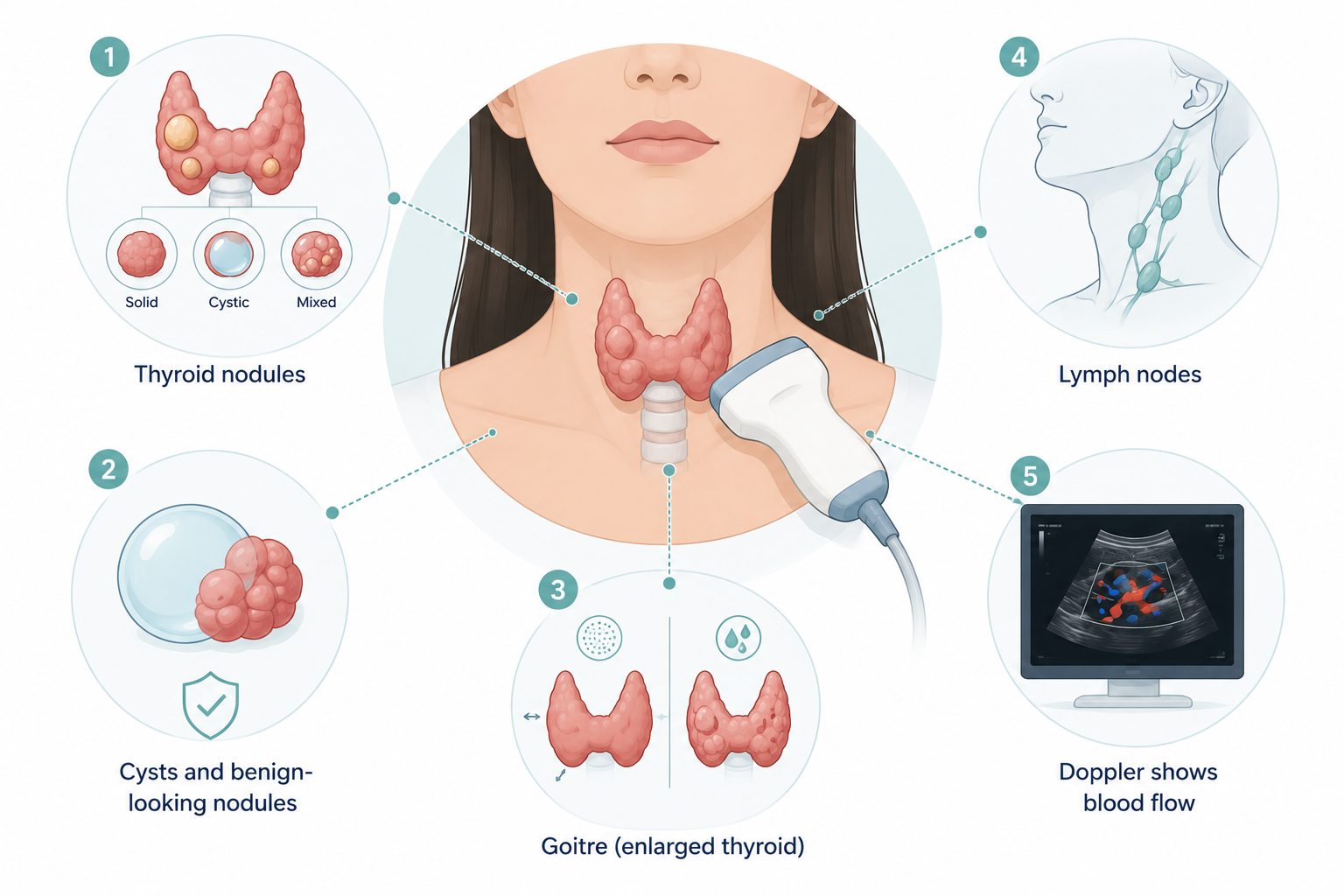
Thyroid nodules
These are lumps inside the thyroid. They can be solid, fluid-filled (cystic), or somewhere in between. The report will usually describe how many there are, their size and where they sit in the gland, as well as their appearance, for example whether the edges are smooth or irregular, and whether there are any small calcifications.
Cysts and benign-looking nodules
Nodules with mainly fluid content or certain reassuring features are often low-risk. Depending on their size and your symptoms, they may simply be monitored with follow-up scans or treated if they’re causing discomfort.
Goitre (enlarged thyroid)
If the thyroid is larger than expected, the report may describe a diffuse enlargement. In autoimmune thyroiditis, such as Hashimoto’s disease, the texture can look more patchy or “coarse”. In Graves’ disease, blood flow on Doppler may appear increased.
Lymph nodes
Neck lymph nodes are sometimes included in the report, especially if there is concern about spread of disease or if a nodule has features that raise the level of suspicion.
Can a thyroid ultrasound always show thyroid cancer?
It’s natural to wonder whether a scan will “catch” cancer if it’s there. Ultrasound is very good at showing nodules and identifying features that raise or lower the suspicion of cancer. Certain patterns are more worrying; others are more reassuring.
But even a detailed scan cannot give a definite diagnosis on its own. When a nodule looks suspicious or reaches a certain size, doctors usually recommend a fine-needle aspiration (FNA) biopsy.
This involves taking a small sample of cells from the nodule, often under ultrasound guidance, and examining them in the laboratory. Some nodules, particularly those with low-risk features, may instead be monitored with repeat scans over time.
How thyroid ultrasound fits into your overall thyroid workup
A thyroid ultrasound tells you how the gland looks. Thyroid blood tests tell you how the gland behaves. In most real-world cases, you need both sets of information to get a full picture.
Here’s how they often work together:
- If your blood tests suggest an overactive or underactive thyroid, ultrasound can show whether the gland is enlarged, inflamed or full of nodules that might be contributing.
- If your blood tests are normal but you have a persistent neck lump or ongoing throat symptoms, ultrasound helps check for structural causes such as nodules or cysts.
- Depending on what the scan shows, your clinician might suggest further tests like a nuclear thyroid scan, CT/MRI or an FNA biopsy, especially if a nodule looks suspicious or you have certain risk factors.
Many patients choose between two broad options:
- Ultrasound alone, when they already have recent blood tests and a specific question about structure (for example, a lump to check).
- A more complete thyroid check, when they want blood tests, ultrasound and an interpretation that pulls everything together.
See which thyroid test is right for you
If you mainly need a lump or swelling checked, a focused thyroid and neck ultrasound is usually enough. If you’d like your thyroid hormones and antibodies checked at the same time, a private thyroid health check brings blood tests and imaging together in one visit.
- View thyroid and neck ultrasound scan details →
- View private thyroid health check options →
- View private blood test options →
How much does a thyroid ultrasound scan in London cost?
Most private thyroid ultrasound scans in London are priced between roughly £150 and £350, with hospital groups and consultant-led services running higher. Where a clinic sits in that range usually comes down to what’s actually included.
At London Private Ultrasound, a thyroid and neck ultrasound is £219. That price covers the scan itself, a consultation with your sonographer, immediate verbal feedback before you leave, and a written report with key images usually sent within 24 hours. No GP referral is needed, and same-day or next-day appointments are often available, including weekends.
The scan isn’t limited to the thyroid gland. It also assesses the cervical lymph nodes, parathyroid glands where visible, and the parotid and submandibular salivary glands. Where nodules are found, they’re classified using the ACR TI-RADS system so the report gives a clear steer on next steps rather than a description alone.
When you’re comparing quotes, it’s worth checking a few things that often sit outside the headline price:
- Whether the scan covers the thyroid only, or the wider neck and lymph nodes
- Whether a written report and stored images are included, or charged as an extra
- Who reports the scan, and how quickly the report is returned
- Whether a consultation or verbal explanation is part of the appointment
- Whether blood tests and a clinical review can be added, or need booking elsewhere
If you want thyroid function assessed alongside structure, the Private Thyroid Health Check is £449 all-inclusive. That bundles the four-region neck ultrasound (£219), a six-marker thyroid blood panel including antibodies (£220), a 30-minute face-to-face GP appointment (£150) and a pharmacist medication review (£50). Booked separately, those come to £639, so the package saves £190.
Private scans are generally chosen when waiting times are a problem, when you want a weekend or same-day appointment, or when you want a fast written report you can share with your own doctor.
Prices can change, so it’s always worth confirming current pricing and inclusions on the service page before you book.
Book a thyroid test with London Private Ultrasound
If you’re living with thyroid symptoms, have noticed a neck lump or have received worrying blood test results, it’s understandable to want clarity sooner rather than later.
Learning what a thyroid ultrasound can and can’t show is a helpful start; arranging the right test is what turns that knowledge into action.
London Private Ultrasound offers focused thyroid and neck ultrasound scans when imaging is the main question, as well as more comprehensive thyroid health checks that combine blood tests and ultrasound in a single visit.
Scans are carried out by clinicians experienced in thyroid and neck imaging, with clear reports and quick turnaround so you can discuss your results promptly with your GP or specialist.
If your main concern is a lump or visible change in your neck, you can book a thyroid and neck ultrasound scan directly from the service page. If you’d prefer a fuller review of thyroid function and structure, you can explore private thyroid health check options that include targeted blood tests.
- Book a thyroid and neck ultrasound at London Private Ultrasound → £219
- Book a private thyroid health check (with blood tests) → £449
Frequently Asked Questions
What is a thyroid ultrasound scan for?
A thyroid ultrasound scan is used to look closely at the thyroid gland and nearby structures in your neck. It helps your clinician check for nodules, cysts, enlargement and other structural changes that might explain your symptoms, blood test results or a neck lump.
How much does a thyroid ultrasound scan cost in London?
Private thyroid ultrasound scans in London typically range from around £150 to £350, depending on what’s included. At London Private Ultrasound the scan is £219, covering the ultrasound, consultation with your sonographer, immediate verbal feedback and a written report usually within 24 hours. The Private Thyroid Health Check, which adds a six-marker blood panel, a 30-minute GP appointment and a pharmacist medication review, is £449.
Do I need to stop eating or taking medication before a thyroid ultrasound?
In most cases, you can eat, drink and take your usual medications as normal before a thyroid ultrasound. There’s no fasting requirement for the scan, and it doesn’t involve injections or contrast dye. If you’ve been given specific instructions for other reasons, follow your doctor’s advice.
How long does a thyroid ultrasound scan take?
A focused thyroid and neck ultrasound usually takes around 15–30 minutes. The exact duration depends on how many areas need to be examined, whether there are multiple nodules and whether nearby lymph nodes and other neck structures are also assessed.
Will a thyroid ultrasound always detect cancer if it’s there?
Thyroid ultrasound is very good at showing nodules and features that help estimate cancer risk, but no imaging test can give a 100% guarantee. If a nodule looks suspicious or reaches a certain size, your doctor may recommend a fine-needle aspiration (FNA) biopsy so cells from the nodule can be examined directly in the laboratory.
Can thyroid ultrasound detect conditions like Hashimoto’s or Graves’ disease?
Ultrasound can show patterns that are typical of autoimmune thyroiditis, such as a more patchy or coarse texture and changes in blood flow. However, diagnoses like Hashimoto’s disease or Graves’ disease still rely heavily on blood tests (for example, hormone levels and thyroid antibodies) and your clinical history.
What happens if my thyroid ultrasound shows a nodule?
If your scan shows a nodule, the next steps depend on its size, appearance and your overall risk factors. Some nodules are monitored with repeat scans, while others may need blood tests, nuclear scanning or an FNA biopsy. Your clinician will talk through the findings with you and explain why a particular plan is recommended.
Is a private thyroid ultrasound scan different from an NHS scan?
The scan itself uses the same basic technology, sound waves to create images of your thyroid. The main differences are usually around waiting times, appointment flexibility, and how the scan is packaged (for example, whether it includes blood tests and a detailed explanation of the results). Many people use private scans to access quicker appointments or more comprehensive thyroid assessments, while still sharing the results with their NHS GP or specialist.