
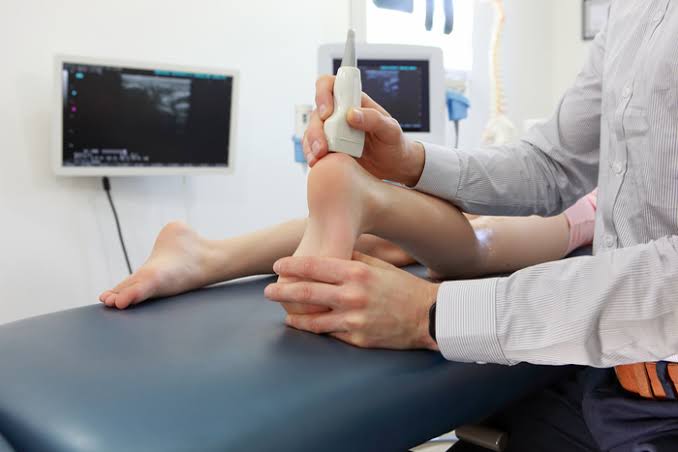
Foot or Ankle Scan
When the problem is in one areafrom £199
- A focused scan of the area that hurts
- Ideal for plantar fasciitis, a Morton’s neuroma or a simple sprain
- Results explained before you leave
- No GP referral, same-day appointments
Foot, heel, ankle and Achilles ultrasound · Harley Street, Central London & St Albans · 7 days a week
A foot and ankle ultrasound is a painless, radiation-free scan of the tendons, ligaments, nerves, joints and lumps in your foot, heel and ankle.
It is used to find the cause of foot, heel or ankle pain, including plantar fasciitis, Achilles tendon problems, ankle sprains and ligament tears, Morton’s neuroma, tendonitis and lumps.
At London Private Ultrasound a foot or ankle scan costs £199 and the combined foot and ankle scan costs £299, with no GP referral needed and results on the day.
The combined foot and ankle scan checks both in one appointment for £299, saving £99. Compare the options.
| Price | One foot or one ankle £199 · both feet or both ankles £299 · foot & ankle £299 one side, £499 both |
|---|---|
| What it checks | Achilles tendon, ankle ligaments, foot and ankle tendons, plantar fascia, nerves, joints, cysts and lumps |
| Common reasons | Plantar fasciitis, Achilles pain, ankle sprain, tendonitis, Morton’s neuroma, lumps, arthritis, sports injury |
| Time | About 25–35 minutes per area · no preparation |
| Results | Explained on the day · written report within 24 hours |
| Referral | No GP referral needed |
| Where & when | 27 Welbeck Street, W1G 8EN · 54–56 Victoria Street, St Albans AL1 3HZ · 7 days, 9am–7pm |
Foot and ankle problems are often linked. Heel pain can come from the plantar fascia or the Achilles, and a bad sprain can hurt tendons in the foot as well as the ankle ligaments. That is why most people choose the combined scan.
from £199

£299
Pick a scan, a clinic and a time. Same-day slots are often available, 7 days a week.
Secure online booking
Choose a time that suits you — we search every eligible specialist and confirm your appointment instantly.
Select any available day in the next 60 days.
Choosing a specialist re-draws the calendar to show only their available dates.
All fields are required unless marked optional.
Use the secure Stripe tabs below to select Card, Google Pay, Apple Pay or Klarna when available.
Payment methods shown depend on your device and the options enabled in Semble Pay. Card details are handled securely by Stripe and are not stored by this website.
Thank you, — a confirmation email has been sent to .
Your scan is booked. Anything selected below will be attached to the same booking and can be paid for at the clinic.
Ultrasound shows the soft tissues that X-rays miss, and can watch them moving.
Tendinopathy, partial tears, rupture and an inflamed bursa behind the heel.
Torn ATFL and CFL ligaments, instability and high ankle sprains.
Peroneal and tibialis posterior tendonitis, tendons that snap, and tarsal tunnel nerve pain.
A thickened or torn plantar fascia, and a thinning heel fat pad.
A swollen nerve between the toes, plantar plate tears and metatarsalgia.
Ganglion cysts, plantar fibromas, gout and arthritis in the foot and ankle joints.
No preparation, no needles and no radiation. You can walk out and carry on with your day.
Tell us where it hurts and how it started. Wear loose trousers or shorts, take off any strapping or compression socks, and bring previous scans or reports.
You lie or sit with your foot supported while the clinician moves a probe over your foot and ankle with warm gel. It is painless.
You point and flex your foot, move your toes or turn your ankle so tendons and ligaments can be seen working. Part of the scan may be done standing.
Results explained before you leave and a written report within 24 hours, with clear advice on next steps such as physiotherapy, insoles, a podiatrist or treatment at our joint pain clinic.
Sharp pain under the heel with the first steps of the day.
An ankle that is still swollen or gives way weeks after you rolled it.
Pain, stiffness or a thickened tendon, often in runners.
Numbness between the toes or a pebble-in-the-shoe feeling.
A new lump on the foot, ankle or in the arch that needs identifying.
A hot, swollen toe joint or ankle that may be gout or arthritis.
Safe, painless and fine to repeat to check how an injury is healing.
Tendons, ligaments, the plantar fascia, nerves and fluid all show clearly.
Ligaments can be stress-tested and tendons seen snapping, which a still MRI can miss.
The clinician presses where it hurts while scanning, so your pain is matched to the picture.
Your painful side can be measured against the other to show how much has changed.
A clear diagnosis guides physiotherapy, insoles, an injection or a specialist opinion.
Your scan is performed and explained by a musculoskeletal specialist. They look at the exact spot that hurts and check how it moves, not just a still picture.
Open 7 days a week from 9am to 7pm, with no GP referral needed. You can often be scanned the day you book.
Findings are explained before you leave, and your written report follows within 24 hours. You can share it with your GP, podiatrist, physio or surgeon.
Choose the Harley Street Medical District in Central London or our St Albans clinic. The same scans and prices apply at both.
Foot, ankle and combined foot and ankle scans at both clinics, 7 days a week from 9am to 7pm, with same-day slots often available.

27 Welbeck Street, London W1G 8EN
Two minutes from Bond Street (Elizabeth, Central and Jubilee lines), five from Oxford Circus and eight from Marylebone. Also close to Marble Arch, Great Portland Street and Regent’s Park stations, and one stop from Paddington or Tottenham Court Road on the Elizabeth line. Easy to reach from Mayfair, Fitzrovia, Soho and Baker Street.

54–56 Victoria Street, St Albans AL1 3HZ
A short walk from St Albans City station, with parking nearby. Serving Hertfordshire and North London, and easy to reach from Harpenden, Hatfield, Radlett, Watford, Borehamwood, Hemel Hempstead, Welwyn Garden City and Luton. Direct Thameslink trains from London St Pancras, Farringdon and Blackfriars.
London Private Ultrasound is a CQC-registered clinic, and the clinicians who scan your foot and ankle and review your results are on the UK’s professional registers. This is who stands behind your scan.
Care Quality Commission
London Private Ultrasound is a CQC-registered clinic, so our service is held to national standards for safe, effective care.
General Medical Council
Our Medical Director, Dr Babak Soleimanpour (GMC 6060555), and the doctors who review your care are on the GMC register.
Health & Care Professions Council
Our Lead MSK Consultant Clinician, Mr Paul Watson (HCPC PH105122), is on the HCPC register for radiographers and allied health professionals.
Royal College of Radiologists
The UK professional body for radiology. Our MSK team includes radiology-trained doctors, and your findings follow in a written report within 24 hours.
Chartered Society of Physiotherapy
Mr Paul Watson is a CSP member, so physiotherapy expertise sits behind your scan and your advice on next steps.

Mr Paul Watson
Lead MSK Consultant ClinicianHCPC · NMP · DipMSK · DFSEM · CSP · PgCert

Dr Adil Naeem
Medical DoctorMBChB · FRANZCR · musculoskeletal radiology

Dr Reza Salehi
Medical DoctorMBChB · FRANZCR · musculoskeletal radiology

Mr Benjamin Iyenkutty
Musculoskeletal SonographerPgCert MSK Ultrasound (UEL) · RCT · SoR
For most ankle pain, ultrasound is the best first scan. It shows the Achilles tendon, the ankle ligaments, the tendons around the ankle bones and any fluid in the joint, and it can watch them move and gently stress a ligament, which MRI cannot do.
An X-ray is the first test if a broken bone is suspected, for example if you cannot put weight on the ankle after an injury. MRI is better for cartilage damage inside the joint, bone bruising and stress fractures. If your scan points that way, we will tell you on the day.
A private ankle ultrasound in London usually costs between about £150 and £350, depending on the clinic and whether one or both ankles are scanned.
At London Private Ultrasound an ankle ultrasound costs £199 for one ankle and £299 for both ankles. If the pain spreads into your heel, arch or the ball of your foot, the combined foot and ankle scan is £299 for one side or £499 for both. Every price includes the scan, results explained on the day and a written report within 24 hours.
You can get a private ankle ultrasound at London Private Ultrasound without waiting for an NHS appointment. We scan ankles at 27 Welbeck Street, London W1G 8EN, in the Harley Street Medical District two minutes from Bond Street station, and at 54–56 Victoria Street, St Albans AL1 3HZ. Both clinics are open 7 days a week, 9am to 7pm, and same-day or next-day appointments are often available.
Yes. You do not need a GP referral for a private ankle ultrasound. You can book directly online or by phone on 020 7101 3377. Physiotherapist and podiatrist referrals are welcome, and your report can be shared with your GP. On the NHS, an ankle ultrasound normally needs a referral from your GP, physiotherapist or hospital doctor.
A foot ultrasound costs £199 for one foot and £299 for both feet. If your ankle or Achilles is also involved, the combined foot and ankle scan is £299 for one side, which saves £99 compared with booking a foot scan and an ankle scan separately. The price includes the scan, results on the day and a written report within 24 hours.
A foot ultrasound shows the plantar fascia and heel fat pad, the nerves between the toes, the plantar plates and joints under the ball of the foot, the tendons of the foot and the midfoot ligaments. It is used for plantar fasciitis, Morton’s neuroma, plantar plate tears, metatarsalgia, tendon problems, joint swelling and gout, and lumps such as ganglion cysts and plantar fibromas. It can also find glass or splinters that an X-ray misses.
An ankle ultrasound shows the Achilles tendon, the ankle ligaments (including the ATFL, the CFL and the high ankle ligament), the peroneal and tibialis posterior tendons, the bursa behind the heel, the ankle joint and the tibial nerve. It is used for Achilles tendinopathy and tears, ankle sprains, tendonitis, a tendon that clicks or snaps, joint swelling and nerve pain. It does not show the inside of bones, so a suspected broken ankle needs an X-ray.
Yes. Ultrasound measures the thickness of the plantar fascia where it attaches to the heel. A thickened, swollen fascia (usually over 4 mm) confirms plantar fasciitis, and the scan can also show a tear, a plantar fibroma or thinning of the heel fat pad, which cause similar heel pain. If treatment is needed, an ultrasound-guided steroid injection can be booked as a separate appointment at our joint pain clinic.
Yes. Ultrasound shows the ligaments torn in a rolled ankle, mainly the ATFL and CFL on the outside of the ankle, and whether they are stretched, partly torn or fully torn. The clinician can gently stress the ankle during the scan to see if it is unstable, and checks the high ankle (syndesmosis) ligament, which is easy to miss and takes longer to heal. This helps decide between physiotherapy and a specialist opinion.
Yes. Ultrasound is one of the main tests for Morton’s neuroma. It shows the thickened nerve between the toes, most often between the third and fourth, measures it and confirms which space it is in. The clinician can gently squeeze the forefoot during the scan to reproduce the click and your symptoms, and checks for problems that feel similar, such as a plantar plate tear or a swollen bursa. If treatment is needed, an ultrasound-guided steroid injection can be booked as a separate appointment at our joint pain clinic.
Yes. Ultrasound shows Achilles tendinopathy (a thickened, painful tendon), partial tears and a complete rupture, and the tendon can be watched as you move your foot. It also checks the bursa behind the heel, which causes similar pain.
If you felt a sudden pop at the back of your ankle and cannot push off or stand on tiptoe, get it checked the same day: call us on 020 7101 3377 or go to A&E, because early treatment matters.
Yes. Ultrasound is the first test for a lump in the foot. It shows whether it is a fluid-filled ganglion cyst on the top of the foot, a plantar fibroma in the arch, a bursa, a Morton’s neuroma or a solid lump, how big it is and where it comes from. Most foot lumps are harmless. If a lump looks unusual, your report will say what further tests are needed, such as an MRI.
An ankle ultrasound takes about 25 to 35 minutes. Scanning both ankles, or the combined foot and ankle scan, takes a little longer. There is no preparation: wear loose trousers or shorts, and remove any strapping, braces or compression socks. Your results are explained before you leave.
Not reliably. Ultrasound can sometimes show swelling over a stress fracture, but it does not show the inside of bones. A stress fracture, bone bruising or a suspected broken bone is best checked with an X-ray first, then MRI if needed. If your symptoms point to a bone problem, we will tell you on the day and advise on the right next step.
Yes. A foot ultrasound is free on the NHS, but you need a referral from your GP, a physiotherapist or a hospital doctor, and waiting times for routine musculoskeletal scans vary by area. People book privately to be scanned the same week, to get an answer before returning to running or sport, or to have a clear diagnosis before seeing a podiatrist, physiotherapist or surgeon. Your report can be shared with your GP.
Yes, we can scan children’s feet in selected cases, for example for a lump, a ganglion cyst or a suspected tendon injury, and the same applies to a child’s ankle. Online booking is for patients aged 18 and over, so please call 020 7101 3377 to book a child’s scan. A parent or guardian must attend.
Medical disclaimer. This page is general information and does not replace individual medical advice. Ultrasound shows soft tissues well but does not show the inside of bones, so a suspected fracture may need an X-ray. Go to A&E if you cannot put any weight on your foot or ankle after an injury, if it looks deformed, if you felt a sudden pop at the back of the ankle and cannot push off, or if a joint is hot, red and swollen with fever. If you have diabetes and a new ulcer or a hot, swollen foot, get medical advice the same day.