
Key takeaways
- Thyroid nodules are very common, and fewer than 10% turn out to be cancer.
- An ultrasound is the best first test, and UK reports grade nodules from U1 to U5.
- A U2 grade is reassuring. U3 to U5 doesn’t mean cancer, but a biopsy is usually the next step.
- Most nodules need no treatment, and benign U2 nodules usually need no further scans.
Most of our patients tell us they found out about their thyroid nodule by accident.
Sometimes it turns up on a scan for something else, or a GP notices a small lump during a routine check.
Our patients also ask us whether they should be worried, but our honest answer is that most thyroid nodules are harmless.
But to really classify it, we always recommend going ahead with an ultrasound of the neck.
Here’s a clear guide to what your nodule means, when to worry, when to rescan, and how to book a thyroid nodule ultrasound in London.
What Are Thyroid Nodules?
Thyroid nodules are lumps that grow inside your thyroid, the butterfly-shaped gland at the front of your neck that makes the hormones controlling your energy and metabolism.
A nodule can be solid, filled with fluid (a cyst), or a mix of both, and you can have one or several.
They’re also far more common than most people realise. A 2026 consensus statement from the British Thyroid Association says thyroid nodules can be found in up to 68% of people when an ultrasound is used to diagnose.
They’re more common in women, and the chances of them appearing increase with age.
These statistics are worth knowing before you worry about finding a nodule yourself.
Are Thyroid Nodules Cancerous?
If this is the question on your mind, here’s the reassuring part: Most thyroid nodules aren’t cancerous, and the same UK consensus statement says fewer than 10% turn out to be cancer.
So the next step is usually about getting on a diagnostic pathway to sort harmless nodules from the few that need a closer look, and an ultrasound is the best first test for that.
What Are the Symptoms of Thyroid Nodules?
Most thyroid nodules usually don’t cause any symptoms. It’s also one of the reasons why people only find out about theirs by chance.
When a nodule is large enough, or if there are several, you might notice:
- a lump or swelling at the front of your neck, just below your Adam’s apple
- a feeling of pressure, or a lump in your throat when you swallow
- a hoarse voice that doesn’t improve
- feeling short of breath when lying flat, if a large goitre presses on your windpipe
Some nodules also tend to increase your thyroid hormone production, which can lead to symptoms such as a racing heart, weight loss or feeling hot and shaky.
If you notice any of these, mention them to your GP, even if they seem small.
What Causes Thyroid Nodules?
There’s no single reason that we can pinpoint for a thyroid nodule, but here are the most common ones:
Benign (colloid or hyperplastic) nodules
Benign nodules are the ones we see most often. They’re simply an overgrowth of normal thyroid tissue, and for most people, they stay harmless.
A thyroid cyst
A thyroid cyst is a nodule filled mostly with fluid. Cysts are usually benign, and if a large one starts to feel uncomfortable, it can often be drained with a fine needle.
A multinodular goitre
A goitre simply means an enlarged thyroid, and a multinodular goitre usually has several nodules. The British Thyroid Foundation says it usually needs no operation unless it’s affecting swallowing or breathing, or growing quickly.
A “hot” nodule
The reason why it’s called a hot nodule is that it tends to make extra thyroid hormone on its own, which can tip you into an overactive thyroid and leave you feeling jittery or hot.
Hashimoto’s thyroiditis
Hashimoto’s is an autoimmune condition that can cause an underactive thyroid and make the gland lumpy or swollen. So if you have hypothyroidism and your scan mentions a nodule, the two are often linked.
Thyroid cancer (less common)
It’s natural for this to be your first worry. Only a small number of nodules turn out to be cancer, and the British Thyroid Foundation says thyroid cancer has a high cure rate.
That’s exactly why we tell our patients that a new nodule is worth checking. A scan either puts your mind at rest or makes sure you’re seen quickly.
Do You Need a Blood Test for a Thyroid Nodule?
We usually recommend combining a blood test with an ultrasound, because it shows whether your thyroid is making too much or too little hormone.
The key test is TSH (thyroid-stimulating hormone). If your TSH is low, a hot nodule could be the reason. If it’s high, your doctor may look for an underactive thyroid, such as Hashimoto’s.

How Does an Ultrasound Check a Thyroid Nodule?
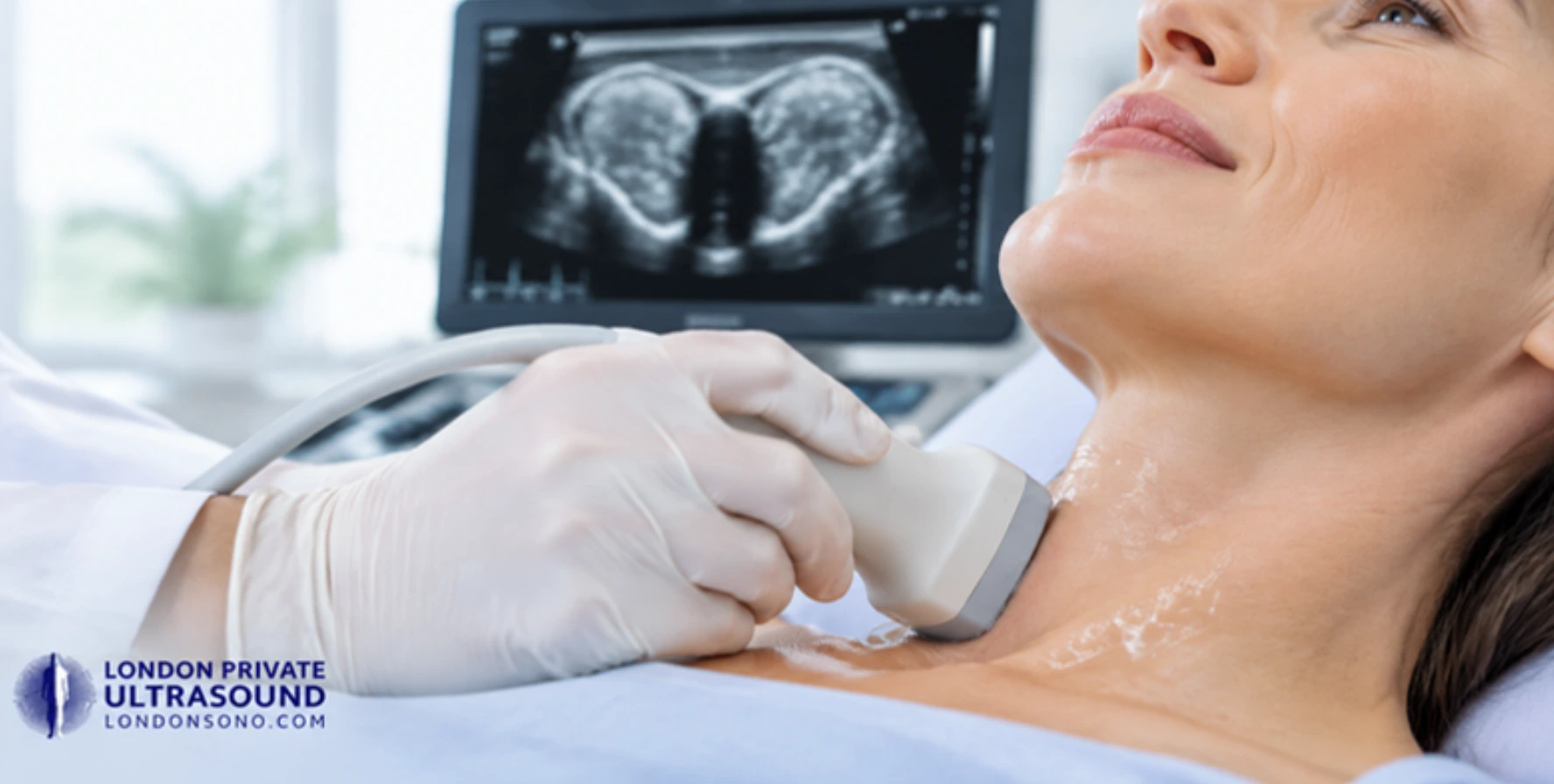
A thyroid ultrasound uses sound waves to build a live picture of your thyroid and every nodule inside it. It’s painless, quick and uses no radiation.
The sonographer scanning you will look at the nodule’s size, whether it’s solid or fluid-filled, its edges, any tiny bright spots called calcifications, its blood flow and your neck lymph nodes.
Together, these features give your nodule a grade, which tells you and your doctor how likely it is to be harmless.
What happens during your thyroid scan
During a thyroid ultrasound, you’ll lie on your back with your neck tilted back slightly, while a small probe with a little warm gel is moved gently across your neck.
The scan itself takes 15 to 30 minutes, and you don’t need to do anything to prepare, apart from wearing an open-necked top.
When you book one at London Private Ultrasound, before you leave, we’ll talk you through what we’ve seen.
What Do U2, U3, U4 and U5 Mean on a Thyroid Ultrasound?
If you’ve had a scan, you’ve probably spotted a “U” grade on your report.
In the UK, most ultrasound reports grade thyroid nodules using the British Thyroid Association’s U1 to U5 system. The higher the number, the more closely your nodule needs to be checked.
Here’s a quick overview of what each grade usually means for you:
| Grade | What it means | What usually happens next |
|---|---|---|
| U1 | Normal, no nodule | Nothing further needed |
| U2 | Benign features | Usually no biopsy, unless there are other concerns |
| U3 | Indeterminate, so unclear either way | Often a biopsy, depending on size |
| U4 | Suspicious features | Biopsy usually recommended |
| U5 | Features that look malignant | Biopsy recommended |
If your report says U2, that’s a reassuring result. It means your nodule has the features of a benign lump, such as a spongy appearance or a fluid-filled part, and for most people that’s the end of the story.
If your report says U3, U4 or U5, try not to jump to the worst conclusion, because it doesn’t mean you have cancer.
An ultrasound can show whether a nodule looks suspicious, but only a fine needle aspiration (FNA) biopsy, where a thin needle takes a few cells to check under a microscope, can confirm what it is.
We don’t perform FNA biopsies at our clinic, but if you need one, we include a referral letter at no extra cost.
For some indeterminate nodules, our thyroid shear wave elastography can also measure how stiff a nodule is. It can add to the picture, but it doesn’t replace a biopsy.
When Should You Worry About Thyroid Nodules?
Most nodules don’t need more than a scan, but it’s best to get yours checked promptly if it’s growing, causing symptoms, or has features on ultrasound that need a closer look.
Here are the signs that mean your doctor will want to look more closely:
- a lump that’s growing quickly over weeks or months
- a lump that feels hard or fixed in place
- a hoarse voice that doesn’t go away
- difficulty swallowing or breathing
- swollen lymph nodes in your neck
- a U3, U4 or U5 grade on your ultrasound
Your doctor will also take extra care if you had head or neck radiation as a child, or have a strong family history of thyroid cancer.
Is a 2.5 cm Thyroid Nodule Large?
A 2.5 cm thyroid nodule is considered to be on the larger side, but its size alone doesn’t tell you whether it’s harmless. In the UK grading system, what the nodule looks like on the scan counts for more than how big it is.
Size does help decide what happens next. The UK consensus suggests considering a biopsy for U3 nodules over 2 cm, while a small U3 nodule under 1 cm may need no follow-up.
When Should a Thyroid Nodule Be Rescanned?
How often a thyroid nodule should be rescanned depends on its grade, its size and any symptoms you have.
Here’s a quick overview based on the 2026 UK consensus:
- Benign U2 nodules. If they’re not causing pressure symptoms, you can usually be discharged with no further scans.
- Nodules that need monitoring. A repeat ultrasound is usually done at 12 months, and scanning any sooner isn’t usually helpful.
- Some U3 to U5 nodules that haven’t been biopsied. These usually need at least 2 years of follow-up scans.
Your specialist will want to see you sooner if your nodule grows or changes, or it’s best to keep note if you notice new symptoms such as hoarseness. If something feels different, don’t wait for your next scan.
How Are Thyroid Nodules Treated?
The good news is that most thyroid nodules don’t need any treatment at all, especially benign nodules that aren’t causing you any symptoms.
Here’s a quick overview of the options when treatment is needed:
- Ablation. Some benign nodules can be shrunk with radiofrequency or other ablation treatments, without surgery.
- Treating a hot nodule. Medicines, radioactive iodine or surgery can calm a nodule making too much hormone.
- Surgery. This may be advised for a large goitre or a nodule that could be cancerous.
How Much Does a Thyroid Ultrasound Cost in London?
A private thyroid ultrasound in the UK usually costs between £150 and £300, depending on who carries out the scan and what’s included.
At London Private Ultrasound, our thyroid and neck ultrasound costs £219 all-inclusive, with U1 to U5 grading, your neck lymph nodes checked, findings explained on the day and a written report with images within 24 hours.
If you want to include thyroid bloods and a GP review too, it’s best to opt for our Thyroid Health Check instead.
Book a Thyroid Nodule Ultrasound in London
Being told you have a nodule can leave you with a lot of questions, and a clear scan is the quickest way to answer them.
At London Private Ultrasound, we’ve been caring for such cases and offering scans for patients in the Harley Street Medical District since 2012.
Here’s why people often choose us for their scans and health packages:
Specialist-led.Your scan is carried out by a registered sonographer or ultrasound consultant in a CQC-registered clinic.
Answers before you leave.We explain your findings on the day, with a written report and images within 24 hours.
Seen quickly.Same-day appointments are often available, 9am to 7pm, seven days a week, with no GP referral.
A clear next step.If you need a biopsy, a referral letter is included at no extra cost.
Trusted by patients.We’re rated 4.8 out of 5 on Google, with over 1,300 reviews.
Here are some other thyroid checks you can book with us:
You’ll find us at 27 Welbeck Street, a short walk from Bond Street station, and at 54–56 Victoria Street, St Albans.
Book your thyroid ultrasound or call us on 020 7101 3377. You can also message us on WhatsApp.
Frequently Asked Questions
Is a thyroid cyst the same as a thyroid nodule?
A thyroid cyst is a type of nodule filled mostly with fluid. Cysts are usually benign, and an ultrasound can tell a cyst from a solid nodule.
Can you shrink thyroid nodules naturally?
There’s no proven diet or supplement that shrinks thyroid nodules. If a benign nodule is causing symptoms, draining a cyst or ablation can reduce its size.
Do I need a GP referral for a thyroid ultrasound?
You don’t need a GP referral for a private thyroid ultrasound at London Private Ultrasound, so you can book directly. You can then share your report and images with your GP or specialist.
Can a thyroid nodule go away on its own?
Some thyroid nodules can shrink or become less noticeable over time, especially fluid-filled cysts, but most solid nodules do not disappear completely. A cyst may also refill after being drained. If a nodule is benign and not causing symptoms, it is usually monitored with occasional ultrasound rather than treated.
Can I have a thyroid ultrasound if I am pregnant?
Yes. A thyroid ultrasound is safe in pregnancy because it uses sound waves rather than ionising radiation. Tell the sonographer and your GP or midwife if you are pregnant, as thyroid hormone levels can change during pregnancy and may need closer monitoring.
Can I take my thyroid medication before an ultrasound?
Yes. Take levothyroxine or any other regular thyroid medication as per your routine, before your scan, unless your own clinician has told you otherwise. The ultrasound looks at the structure of the thyroid and does not require you to stop or delay medication.
Can a thyroid ultrasound tell if a nodule is cancer?
No. An ultrasound can show whether a nodule has reassuring or suspicious features, but it cannot definitively diagnose cancer. A U2 result is generally reassuring, while U3 to U5 nodules may need a fine-needle aspiration biopsy to examine cells under a microscope.
Author and Medical Reviewer

Medical Ultrasound Specialist · MD
Medical ultrasound specialist and Clinical Vascular Scientist, registered with BMUS, SVT, SoR and RCT.

Private GP · MBBS BSc (Hons) MRCGP
Trained at Imperial College London and a Member of the Royal College of General Practitioners.
Published Last reviewed