
Low libido & erections
A drop in sex drive, or erections that are softer or less reliable, is one of the most common reasons men check their hormones. Low testosterone, a raised prolactin and oestradiol imbalance can all contribute.
Private men’s hormone assessment · Central London & St Albans
A private men’s hormone profile at London Private Ultrasound costs £729. Rather than checking testosterone on its own, it looks at the hormones that work together — testosterone (total and free), SHBG, free androgen index, oestradiol, prolactin, LH, FSH and DHEA-S — plus your thyroid, blood sugar and cholesterol. You also get a testicular ultrasound and a GP appointment to explain what your results mean, face to face. No GP referral needed, and nothing is left as a set of numbers for you to work out on your own.
Fatigue, low libido, low mood, poor concentration and lost strength can all trace back to your hormones, but they can equally come from your thyroid, your blood sugar or your iron. This profile measures the whole picture in one visit, so what you do next is based on the full picture, not on a single number.
Diagnosis first, treatment when you need it: if your results call for it, our GP can refer you to the right specialist to begin treatment. That is arranged separately — additional cost applies.
| Price | £729 all-inclusive · no hidden fees |
|---|---|
| Hormones measured | Total testosterone · free testosterone · SHBG · free androgen index · oestradiol · prolactin · LH · FSH · DHEA-S |
| Also included | Thyroid (TSH, free T4) · glucose & HbA1c · full lipid profile · PSA · full blood count, kidney, liver, bone and iron studies · testicular ultrasound · GP appointment · written report |
| Also known as | Male hormone profile · men’s hormone blood test · hormone test for men · male hormone panel |
| Common reasons to test | Low libido · fatigue · low mood · erectile difficulties · loss of muscle or strength · suspected low testosterone · monitoring TRT |
| Appointment time | Allow around 60–90 minutes for bloods, scan and consultation |
| Best time to book | Morning, ideally before 11am, when testosterone is at its highest and gives the most reliable reading |
| Preparation | Bring a list of medication and supplements; tell us if you use a testosterone gel. Fasting guidance for the metabolic markers is confirmed when you book. |
| GP referral | Not required — book directly |
| Results | Scan findings on the day · blood results typically within about 3 working days |
| Locations | 27 Welbeck Street, Central London W1G 8EN · 54–56 Victoria Street, St Albans AL1 3HZ |
| Availability | 7 days a week, 9am–7pm · same-day appointments often available |
There is no single symptom that proves a hormone problem, and that is exactly why it is so often missed. These are the signs worth testing for — but each also has non-hormonal causes, which is why they are measured together rather than guessed at.
A drop in sex drive, or erections that are softer or less reliable, is one of the most common reasons men check their hormones. Low testosterone, a raised prolactin and oestradiol imbalance can all contribute.
Tiredness that rest does not fix is a classic low-testosterone symptom, but it overlaps heavily with thyroid disease, low iron, poor sleep and diabetes — all of which this panel checks in the same visit.
Flat mood, irritability, loss of motivation and brain fog can be driven by testosterone, thyroid function or blood sugar. Measuring them together avoids treating the wrong thing.
Losing muscle and strength despite training, or gaining fat around the middle, can reflect falling androgen levels. Free testosterone and the free androgen index show what is actually available to your body.
Disturbed sleep, night sweats and hot flushes are under-recognised signs of hormonal change in men, sometimes described as andropause or the “male menopause”.
Breast tissue (gynaecomastia), shrinking or softening testicles, or reduced facial and body hair are more specific pointers that make measuring LH, FSH and oestradiol especially worthwhile.
Symptoms cannot confirm it, and normal testosterone cannot rule it out. A total testosterone that looks fine can still sit alongside a low free level if SHBG is high, and every symptom above has causes that have nothing to do with hormones. The only reliable way to tell is to measure the full network in the morning and read it in context — which is what this profile is built to do.
A useful hormone profile for men measures far more than testosterone. Hormones act as a network, so this panel reads them together — and adds the thyroid, metabolic and general markers that so often explain “hormonal” symptoms.
The core of the profile.
These locate the cause of any low testosterone.
The balance around testosterone.
Thyroid disease mimics low testosterone almost exactly, so it is measured alongside.
Metabolic health drives, and is driven by, testosterone.
Because fatigue and low libido often start here.
Not just a blood panel. Every hormone profile here also includes a testicular ultrasound and a GP appointment to explain the results in person, plus a written report. That is the difference between a set of numbers and an answer.
A list of hormones is not much use on its own. This is the reasoning your GP works through when your results come back.
| What is measured | What it checks for | Why it matters |
|---|---|---|
| Total testosterone, free testosterone, SHBG, free androgen index | How much testosterone you have, and how much is actually available | A normal total with a high SHBG can still leave you functionally low. Measuring only the total is the most common reason a hormonal cause gets missed. |
| LH and FSH | Whether a low testosterone is coming from the testicles or the pituitary | Low testosterone with high LH and FSH points to the testicles (primary); with low or normal LH and FSH it points to the pituitary (secondary). This is what turns a number into a diagnosis. |
| Prolactin | A pituitary cause | A significantly raised prolactin suppresses testosterone and can point to a specific, treatable pituitary problem that is easily missed without the test. |
| Oestradiol | The testosterone-to-oestrogen balance | Raised oestradiol, often linked to excess weight, can lower libido and mood; very low levels affect bone and joints. It also matters for anyone on or considering TRT. |
| DHEA-S | The main adrenal androgen | Gives context to the wider androgen picture and adrenal contribution, particularly when testosterone is borderline. |
| TSH and free T4 | Thyroid function | Both an underactive and an overactive thyroid cause fatigue, low libido and mood change — the same symptoms as low testosterone, and both are treatable. |
| HbA1c, glucose and lipids | Diabetes, prediabetes and cardiovascular risk | Metabolic health and testosterone are tightly linked. Undiagnosed diabetes is a common finding behind “hormonal” symptoms. |
| Full blood count, kidney, liver and iron studies | General health, anaemia, organ function | Fatigue and low libido frequently trace back here. Haematocrit and liver results also matter if testosterone treatment is ever discussed. |
| Testicular ultrasound | Structure and volume of the testicles | Small firm testes support a testicular cause of low testosterone; the scan can also find a varicocele, cyst, hydrocele or mass. |
A note on PSA. PSA is included with your consent because it gives useful context before any hormone treatment and alongside urinary symptoms. It is not a straightforward marker: it rises with prostate enlargement, inflammation and infection as well as cancer, and a raised result can lead to further investigation. Your GP will explain what the result does and does not mean. If you would rather not have PSA measured, tell the team before your blood is taken.
A finger-prick kit through the post gives you numbers on a screen. This is a full clinical assessment that tells you what those numbers mean and what to do about them — in one visit, at a CQC-registered clinic.
Your results are interpreted by a doctor who takes your history and examines you where appropriate — not returned as a colour-coded PDF for you to decode alone.
Testicular volume and structure add real information to a hormone result, and can only be assessed in person. It is included at no extra cost.
A phlebotomist takes a proper venous sample in the morning, which is more reliable than a home finger-prick for several of these hormones.
Thyroid, blood sugar, cholesterol, iron and a full blood count are measured in the same draw, because these are what so often explain “hormonal” symptoms.
You leave with a clear report and, if needed, a referral letter containing confirmed results — useful with your NHS GP or a specialist.
Bloods, scan and doctor together, seven days a week, at two London clinics, with no GP referral required and same-day slots often available.
There is no fixed age. If any of the following fits, a hormone profile is a sensible first step rather than putting the symptoms down to stress or ageing.
Low libido, fatigue, low mood, poor concentration or lost strength that has become the norm rather than the odd off week.
Testosterone declines gradually from around 30. A baseline in your thirties or forties is useful for tracking change over time.
If you have read about low T and think it fits, testing the full network confirms or rules it out and shows the cause.
Already on testosterone replacement therapy and want your testosterone, oestradiol, prolactin and blood count checked and timed properly.
LH, FSH and prolactin give useful context alongside a dedicated semen analysis if you are trying to conceive.
Getting a proper baseline before any supplement, gel or treatment means you can tell later whether it is actually working.
Bloods, scan and a doctor in a single, unhurried visit. Allow around 60 to 90 minutes.
Testosterone peaks in the morning, so a morning appointment avoids a falsely low reading. Bring a list of every medication and supplement, and tell us if you use a testosterone gel.
You are shown to a private room. The visit is discreet from the moment you arrive.
A single venous draw from the arm covers every hormone and every other marker in the panel.
A towel covers everything except the area being scanned. Warm gel and a small probe, about fifteen minutes, nothing enters the body and no radiation is used.
A doctor takes your history, asks about your symptoms, examines you where appropriate, and explains what the hormones are looking for and the possible next steps.
Scan findings are explained on the day. Blood results follow, with the hormone panel taking around three working days, and your written report sets out the findings, ranges and recommended next step.
One price covers the whole assessment. There are cheaper blood-only hormone tests, but they are not comparing like with like.
| Full male hormone panel (testosterone, free T, SHBG, FAI, oestradiol, prolactin, LH, FSH, DHEA-S) | Included |
| Thyroid, glucose & HbA1c, full lipid profile | Included |
| PSA, full blood count, kidney, liver, bone & iron studies | Included |
| Testicular ultrasound | Included |
| GP appointment & results explained in person | Included |
| Written report & referral letter if needed | Included |
| Total, all-inclusive | £729 |
A postal, blood-only male hormone profile is typically £40–£120 and stops at the numbers. This price includes the imaging, the wider bloods and a doctor to interpret it, in one visit.
Book Hormone Profile · £729What happens after your diagnosis. London Private Ultrasound is a diagnostic and concierge clinic: the £729 covers the bloods, the ultrasound, the GP appointment and your report. If your results show something that needs treatment — such as testosterone replacement therapy, or treating a thyroid or prolactin problem — our GP can refer you to the right specialist to start it. That specialist appointment and any treatment are arranged separately and are not included in the £729 (additional cost applies).
Two clinics, open seven days a week, with morning appointments for reliable hormone results and same-day slots often available.
27 Welbeck Street, London W1G 8EN. A short walk from Bond Street, Oxford Circus and Marylebone.
54–56 Victoria Street, St Albans AL1 3HZ. Convenient for Hertfordshire and north London.
Professional bodies and regulators relevant to clinical governance, standards and registration.

Professional standards, education and guidance for clinical radiology and clinical oncology.

Official register and professional standards for doctors and regulated medical associates.

Independent regulator of health and adult social-care services in England.

Official register for regulated health and care professionals, including radiographers.

Professional standards, education and support for surgical practice and patient care.
Results are interpreted by a GP, not returned as a laboratory printout. Your scan is performed by an experienced ultrasound clinician within the same visit.
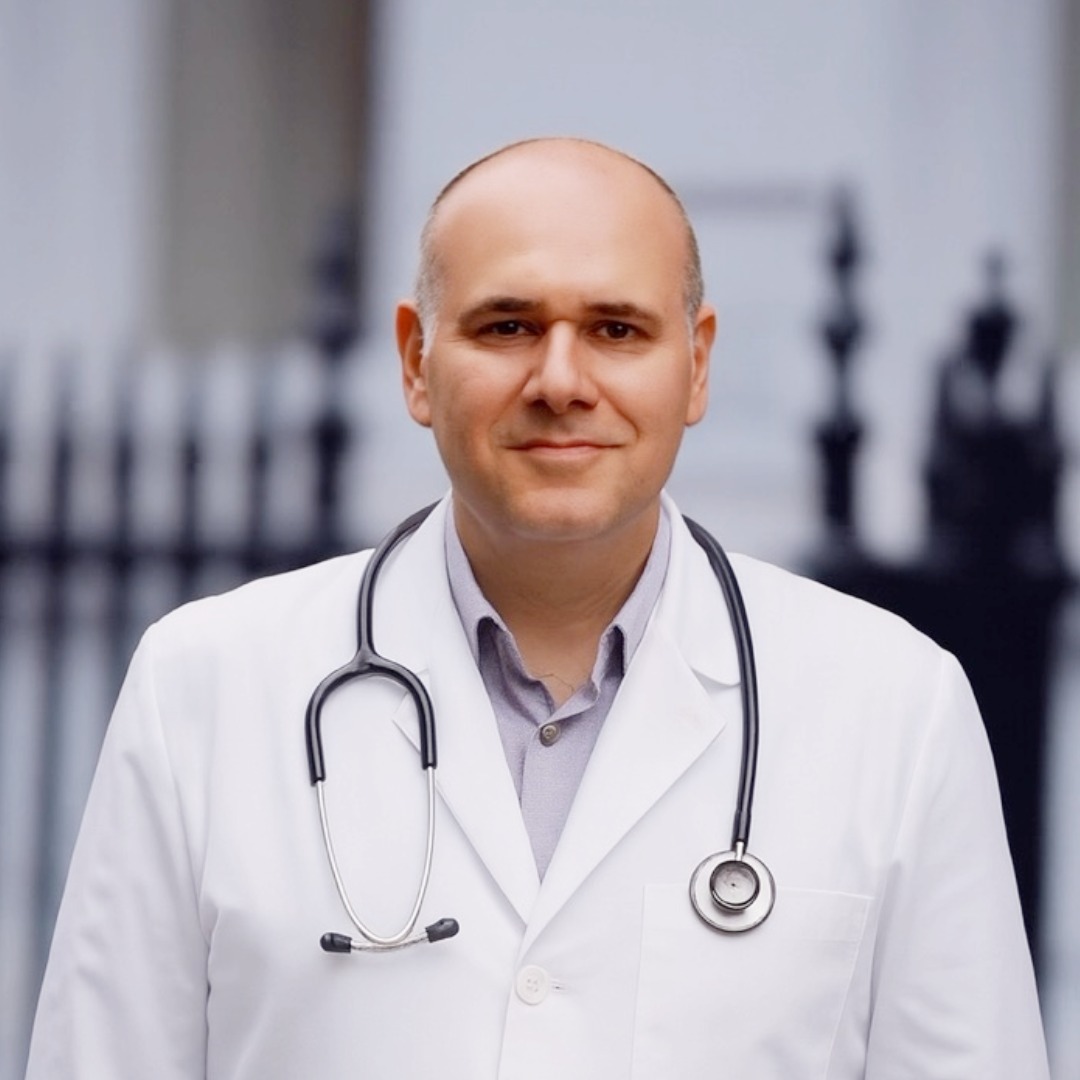
MD · MRCGP · DRCOG · Overall clinical governance responsibility

Reporting clinician · HCPC / BMUS registered · experienced in diagnostic ultrasound and patient-centred reporting

Co-founder of London Private Ultrasound

Co-founder · CQC Champion ensuring compliance with Care Quality Commission standards
£729 for the full hormone panel, the wider bloods, the testicular ultrasound and the GP appointment, in one visit. Morning slots give the most reliable hormone results. Call 020 7101 3377 if you would like to talk it through first.
There is no single symptom that proves it, which is the whole problem. The common signs are low libido, erectile difficulties, fatigue that does not lift with rest, low mood or irritability, poor concentration, loss of muscle and strength, more body fat around the middle, disturbed sleep and hot flushes.
Because every one of these also has non-hormonal causes, symptoms alone cannot confirm a hormone imbalance, and normal-looking testosterone does not rule one out. The only reliable way to tell is to measure the hormones that work together as a network, in the morning, and read them alongside thyroid, blood sugar and a general health screen so the real cause is not missed.
A total testosterone around 300 ng/dL, which is roughly 10.4 nmol/L, sits near the bottom of most laboratory reference ranges and is the level many guidelines use as a threshold for considering testosterone deficiency, particularly when a man has symptoms. It is not a diagnosis on its own.
A single low reading should be repeated on a fresh morning sample, and it should be interpreted with free testosterone and SHBG, because a total of 300 means something different depending on how much is actually available to your tissues. LH and FSH then show whether a genuinely low level is coming from the testicles or from the pituitary. Ranges and units also vary between laboratories, so the number matters less than the full picture and your symptoms.
A full male hormone panel goes well beyond testosterone. It should include total testosterone, free testosterone, SHBG and free androgen index for testosterone status; LH and FSH to locate the cause of any deficiency; prolactin, which can suppress testosterone when raised; oestradiol for the testosterone-to-oestrogen balance; and DHEA-S, the main adrenal androgen.
Because hormone symptoms overlap so heavily with thyroid disease, diabetes and anaemia, a genuinely useful panel also checks thyroid function, blood sugar and HbA1c, cholesterol and a general health screen. This assessment covers all of that in one blood draw, and adds a testicular ultrasound and a GP appointment to interpret it.
Naturally high testosterone rarely causes problems and is usually noticed only on a blood test. When testosterone is high because of anabolic steroid or supplement use, the tell-tale pattern is a raised or high-normal testosterone with suppressed LH and FSH, sometimes with raised oestradiol, a rising red blood cell count and shrinking testicles.
Possible outward signs include acne, oily skin, irritability or aggression, difficulty sleeping and, over time, reduced fertility. The only way to confirm high testosterone and understand why is to measure it alongside LH, FSH, oestradiol and a blood count, which this panel does.
A private men’s hormone profile at London Private Ultrasound is £729, all-inclusive. That covers the full hormone panel, the wider thyroid, metabolic and general-health bloods, a testicular ultrasound, a GP appointment and your written report.
A blood-only hormone profile from a postal-kit provider is cheaper, often £40 to £120, but it does not include a doctor to interpret the result, imaging, or the broader markers that explain hormone symptoms. Compare what is actually in the price rather than the headline figure.
This is a clinic-based assessment rather than a postal finger-prick kit, and that is deliberate. A venous blood sample taken in the morning by a phlebotomist is more reliable than a home finger-prick for several of these hormones, the testicular ultrasound can only be done in person, and a GP explains the results to you rather than emailing a set of numbers.
If travelling in is difficult, call us and we will talk through the options, including our home-visit service.
No. You can book directly, without a referral from your NHS GP. If you have recent blood results, a hospital letter, or a list of your current medication and supplements, bring them, as they add useful clinical context.
Testosterone follows a daily rhythm and is at its highest in the morning, so an afternoon sample can read low in a man whose levels are actually normal, and most reference ranges are based on morning samples. Booking a morning slot, ideally before 11am, avoids a result that has to be repeated. Fasting guidance for the blood sugar and cholesterol markers is confirmed when you book.
Total testosterone is all the testosterone in your blood. Most of it is bound to proteins, mainly SHBG and albumin, and is not available for your body to use. Free testosterone is the small unbound fraction that is actually active.
A man can have a normal total testosterone but a low free level if his SHBG is high, which is a common reason a hormonal cause gets missed. This panel measures total testosterone, SHBG and free testosterone together, and calculates the free androgen index, so the available testosterone is clear rather than assumed.
LH and FSH are the signals the pituitary gland sends to the testicles. If testosterone is low and LH and FSH are high, the problem is usually in the testicles themselves, which is called primary hypogonadism. If testosterone is low and LH and FSH are low or unexpectedly normal, the problem is higher up, in the pituitary or hypothalamus, which is secondary hypogonadism.
Measuring LH and FSH is what turns a lone low testosterone into an answer about where the fault lies, which is why a hormone profile without them is incomplete.
It includes a testosterone test but is much more than one. A standalone testosterone test gives a single number that is easy to misread.
This profile measures testosterone in context, with free testosterone, SHBG, LH, FSH, prolactin, oestradiol and DHEA-S, alongside thyroid, metabolic and general-health markers and a testicular ultrasound, so a result can actually be explained rather than just reported.
Yes. The panel measures the markers used to monitor testosterone replacement therapy, including testosterone, SHBG, oestradiol, prolactin and a full blood count for haematocrit, and the GP can advise on timing the test around your treatment schedule.
If you use a testosterone gel, tell the team, because gel on the skin or under the nails can contaminate a sample and falsely raise the reading. Never change a prescribed dose without speaking to your prescriber; this assessment gives you and your clinician the numbers to work from.
Testosterone declines gradually from around the age of 30, but an imbalance can occur at any age. Common contributors include excess weight and insulin resistance, type 2 diabetes, an underactive or overactive thyroid, a raised prolactin from a pituitary cause, chronic stress, poor sleep, heavy alcohol use, certain medications and anabolic steroid use, and problems within the testicles themselves.
Because the causes are so varied, a single testosterone reading rarely explains the picture, which is why the profile measures the whole network at once.
It is not needed for every man, but it adds real value here. Testicular volume and structure help interpret a hormone result: small, firm testes support a testicular cause of low testosterone, and the scan can also identify a varicocele, cyst, hydrocele or, rarely, a mass that would change what happens next.
It takes about fifteen minutes, nothing enters the body and no radiation is used. It is included at no extra cost as part of the assessment.
Ultrasound findings are explained on the day. Blood results follow, with the hormone profile being the longest at around three working days, so the full picture is normally with you within about three days of the visit. Your report sets out the findings, the reference ranges and the recommended next step.
Your GP explains the finding and what it means, and sets out the next step, which might be a repeat test at the right interval, a lifestyle plan, treatment of an underlying cause such as thyroid disease or a raised prolactin, or referral to an endocrinologist or urologist where that is appropriate.
A referral letter is included at no extra charge. Where treatment is needed, our GP can refer you to the right specialist to start it — for example for testosterone replacement therapy — as part of our concierge pathway. That specialist appointment and any treatment are arranged separately and are not included in the £729 (additional cost applies).
London Private Ultrasound has two clinics. Central London is at 27 Welbeck Street, W1G 8EN, in the Harley Street Medical District, a short walk from Bond Street, Oxford Circus and Marylebone. St Albans is at 54–56 Victoria Street, AL1 3HZ.
Both are open seven days a week, 9am to 7pm, with same-day appointments often available.
Medical disclaimer. This page is general information and does not replace individual medical advice. Blood tests and ultrasound identify contributing factors and must be interpreted alongside your history and examination; a single result does not on its own confirm or exclude a hormone disorder, and testosterone in particular should be assessed on a morning sample and usually confirmed on repeat testing. Reference ranges vary between laboratories. Do not start, stop or change any treatment, including testosterone replacement therapy, without speaking to a qualified prescriber. London Private Ultrasound is a diagnostic and concierge service; any specialist appointment or treatment arranged after your diagnosis is separate from this assessment and charged separately (additional cost applies).