
Knee tendon, ligament and Baker’s cyst ultrasound · Harley Street, Central London & St Albans · 7 days a week
Private Knee Ultrasound Scan in London
A knee ultrasound is a painless, radiation-free scan of the tendons, ligaments, bursae and soft tissues around your knee.
It is used to find the cause of knee pain and swelling, including jumper’s knee, a Baker’s cyst, bursitis, ligament sprains, runner’s knee and lumps.
At London Private Ultrasound a knee scan costs £199 for one knee and £299 for both knees, with no GP referral needed and results on the day.
- From £199
- No GP referral
- Same-day appointments
- Results on the day
- Moving (dynamic) assessment
- Open 7 days, 9am–7pm
Book both knees for £299 and save £99, with your two sides compared in one visit. Compare the options.
Knee Ultrasound at a Glance
| Price | One knee £199 · both knees £299 (save £99) |
|---|---|
| What it checks | Tendons, collateral ligaments, bursae, IT band, Baker’s cyst, joint fluid and lumps |
| Common reasons | Jumper’s knee, Baker’s cyst, bursitis, ligament sprain, runner’s knee, swelling, sports injury |
| Time | About 20–30 minutes per knee · no preparation |
| Results | Explained on the day · written report within 24 hours |
| Referral | No GP referral needed |
| Where & when | 27 Welbeck Street, W1G 8EN · 54–56 Victoria Street, St Albans AL1 3HZ · 7 days, 9am–7pm |
One Knee or Both: Which Knee Scan Do You Need?
Book one knee if only one side hurts. Choose both knees if both hurt, or to compare the painful knee with the other in the same visit.
One Knee
When only one knee hurts£199
Full scan of the painful knee
- Tendons, ligaments, bursae and IT band checked
- Baker’s cyst and joint fluid assessed
- Moving (dynamic) assessment included
- Results explained before you leave
Both Knees
Both sides compared in one visit£299
Save £99 compared with two single-knee scans.
- Everything in the one-knee scan, on both sides
- Left-versus-right comparison of tendons and ligaments
- Both knees checked for a Baker’s cyst
- Best for runners, athletes and arthritis
Book Your Knee Ultrasound
Choose one knee or both knees below. Same-day and next-day appointments are often available at both clinics, 7 days a week.
Secure online booking
Book your scan
Choose a time that suits you — we search every eligible specialist and confirm your appointment instantly.
- 1Appointment
- 2Your details
- 3Payment
- 4Confirmed
Choose another date
Select any available day in the next 60 days.
Available times
Choosing a specialist re-draws the calendar to show only their available dates.
Your appointment
- Scan type
- Branch
- Date of scan
- Specialist
- Scan Time
- Price
Your details
All fields are required unless marked optional.
Appointment available
Secure payment
Use the secure Stripe tabs below to select Card, Google Pay, Apple Pay or Klarna when available.
Payment methods shown depend on your device and the options enabled in Semble Pay. Card details are handled securely by Stripe and are not stored by this website.
Your appointment is confirmed
Thank you, — a confirmation email has been sent to .
Your scan is booked. Anything selected below will be attached to the same booking and can be paid for at the clinic.
Booking confirmed
What a Knee Ultrasound Scan Includes
A structure-by-structure scan of everything around the knee that commonly causes pain and swelling, with the knee moving.
Quadriceps & patellar tendons
The tendons above and below the kneecap, checked for tendinopathy and tears.
Collateral ligaments
The MCL and LCL, gently stress-tested for sprains and tears.
Bursae
The fluid sacs at the front and inner knee, checked for swelling and inflammation.
Baker’s cyst & joint fluid
The back of the knee for a Baker’s cyst, and the joint for fluid.
IT band & outer knee
The iliotibial band where it crosses the outer knee, a common runner’s problem.
Fat pad, nerve & meniscal edges
Hoffa’s fat pad, the peroneal nerve and the outer edges of the menisci.
What Can a Knee Ultrasound Detect?
Ultrasound finds the specific cause of most soft-tissue knee pain, so you know what you are dealing with and what to do next.
Jumper’s knee
Patellar tendinopathy and tendon tears from running, jumping and sport.
Baker’s cyst
A swelling behind the knee, measured and checked for rupture into the calf.
Bursitis
Housemaid’s knee, infrapatellar and pes anserine bursitis.
Ligament sprains & tears
MCL and LCL injuries after a twist or a knock.
Runner’s knee
IT band syndrome, a common cause of outer knee pain in runners and cyclists.
Joint fluid, lumps & cysts
Fluid and arthritis changes in the joint, ganglions, lipomas and other lumps.
Where MRI is better. The cruciate ligaments (ACL and PCL), the central meniscus, the cartilage and the bone sit deeper and show best on MRI. If your scan points that way, we will tell you on the day.
How to Prepare for Your Knee Ultrasound
There is nothing to do beforehand: no fasting, no medication changes and no radiation.
Tell us which knee
One knee or both, and any injury, previous scans, injections or surgery.
Loose trousers or shorts
Trousers that roll above the knee, or shorts, so the knee can be reached easily.
Previous imaging
Earlier X-ray, ultrasound or MRI reports. A female clinician can be requested at booking, subject to availability.
Expect to bend the knee
You bend, straighten and gently load the knee so tendons and ligaments can be seen working. Results are explained before you leave.
Why People Choose London Private Ultrasound for Their Knee Scans
MSK-specialist clinicians
Your knee is scanned and reported by clinicians with specialist musculoskeletal expertise. Every scan is personally interpreted, not outsourced.
Dynamic, real-time assessment
We image the knee moving and under load. Snapping tendons and loose ligaments are seen live, which a still MRI cannot show.
Results the same day
Findings are explained in the room. A written report with images follows within 24 hours for your GP, physio or surgeon.
Treatment under one roof
If the scan shows a treatable problem, an ultrasound-guided knee injection or aspiration can often be arranged. It is booked and charged separately.
No referral, no waiting
Book directly, with same-day and next-day knee appointments often available. Bring any previous imaging and we will factor it into your report.
Harley Street, seven days a week
Central London and St Albans, open 9am to 7pm every day. CQC-registered, established 2012 and rated 4.8 from over 1,300 reviews.
Scans & Treatments People Book at London Private Ultrasound

Combined MSK Health Check
A knee ultrasound and a consultant orthopaedic assessment in one 60-minute appointment, with a treatment plan and a combined report.
Orthopaedic Consultation
A face-to-face consultant assessment of your knee, with an examination, a review of your scan and a personalised treatment plan.
Hip Ultrasound Scan
For hip, groin and upper thigh pain, useful when knee pain is coming from the hip or more than one joint is involved.
Knee Ultrasound Near Me: Central London and St Albans
The same knee scan at both clinics, 7 days a week from 9am to 7pm, with same-day slots often available.

Central London: Harley Street Medical District
27 Welbeck Street, London W1G 8EN
Two minutes from Bond Street (Elizabeth, Central and Jubilee lines), five from Oxford Circus and eight from Marylebone.

St Albans: Hertfordshire
54–56 Victoria Street, St Albans AL1 3HZ
A short walk from St Albans City station, with parking nearby. Serving Hertfordshire and North London.
Clinical Governance and Professional Registers
Professional bodies and regulators relevant to clinical governance, standards and registration.

The Royal College of Radiologists
Professional standards, education and guidance for clinical radiology and clinical oncology.

General Medical Council
Official register and professional standards for doctors and regulated medical associates.

Care Quality Commission
Independent regulator of health and adult social-care services in England.

Health and Care Professions Council
Official register for regulated health and care professionals, including radiographers.

Royal College of Surgeons of England
Professional standards, education and support for surgical practice and patient care.
Meet Your Musculoskeletal Team

Mr Paul Watson
Lead MSK Consultant ClinicianHCPC · NMP · DipMSK · DFSEM · CSP · PgCert

Dr Adil Naeem
Medical DoctorMBChB · FRANZCR · musculoskeletal radiology

Dr Reza Salehi
Medical DoctorMBChB · FRANZCR · musculoskeletal radiology

Mr Peyman Bakhshayesh
Consultant Trauma & Orthopaedics SurgeonFBOA · MBA · MD · PhD · orthopaedic consulting partner
Knee Ultrasound: Frequently Asked Questions
How much does a knee ultrasound cost in London?
At London Private Ultrasound a knee ultrasound costs £199 for one knee and £299 for both knees, all-inclusive, at our Central London and St Albans clinics. Across the UK, private knee ultrasound scans typically advertise from around £135 to £300.
Our price includes the scan, a moving (dynamic) assessment, results explained on the day and a written report within 24 hours. Booking both knees saves £99 compared with two separate scans.
Can you do an ultrasound on your knee, and what will it show?
Yes. A knee ultrasound is the recommended first scan for most soft-tissue knee pain. It shows the quadriceps and patellar tendons, the collateral ligaments, the bursae, the IT band, Hoffa’s fat pad, a Baker’s cyst, fluid in the joint and the outer edges of the menisci.
It identifies tendinopathy and tendon tears, bursitis, ligament sprains, runner’s knee, Baker’s cysts, joint fluid and lumps, and can show problems that only appear when you bend or load the knee.
Which is better for knee pain, an ultrasound or an MRI?
For the tendons, collateral ligaments, bursae, IT band and a Baker’s cyst, ultrasound is an excellent first test, and it can image the knee moving and under load, which MRI cannot.
MRI is better for the cruciate ligaments (ACL and PCL), the central meniscus, the cartilage and the bone. If your scan suggests one of those problems, we will tell you that an MRI is the right next step.
Can a knee ultrasound detect a meniscus tear?
Only partly. Ultrasound can see the outer edges of the meniscus and can find meniscal cysts and some tears there, but it cannot reliably see the central and back parts, which sit deep inside the joint. MRI is the best test for a suspected meniscal tear, and we will advise on the day whether you need one.
Can a knee ultrasound diagnose a Baker’s cyst?
Yes. Ultrasound is the ideal test for a Baker’s (popliteal) cyst. It confirms the cyst, measures it, checks whether it has burst into the calf, and can guide drainage or an injection where that is appropriate. It is one of the most common reasons people book a knee scan.
Can a knee ultrasound assess the IT band and runner’s knee?
Yes. Ultrasound shows the iliotibial (IT) band where it crosses the outer knee, and it can be checked as the knee bends, which helps confirm IT band syndrome in runners and cyclists. Jumper’s knee (patellar tendinopathy) is also seen clearly, so the scan suits most sports-related front and outer knee pain.
Can ultrasound show a soft-tissue lump around the knee?
Yes. Ultrasound is the first test for a lump or swelling around the knee. It can tell apart common lumps such as a Baker’s cyst, ganglion, bursal swelling or lipoma. If a lump looks unusual, the clinician will advise an MRI and a specialist referral.
Should I book one knee or both knees?
Book one knee at £199 if only one side hurts. Choose both knees at £299 if both hurt, if comparing the painful knee with the other would help, or if you are being checked for a condition that affects both, such as arthritis. Both knees saves £99 compared with two separate scans.
How long does a knee ultrasound take?
Allow about 20 to 30 minutes for one knee, or a little longer for both. Your findings are explained straight after the scan, and the written report follows within 24 hours.
When will I get my knee scan results?
The clinician explains what they have found straight after the scan and answers your questions. A full written report with images follows the same day or within 24 hours, and we can send it directly to your GP, physiotherapist or specialist on request.
Is a knee ultrasound painful, and how is it done?
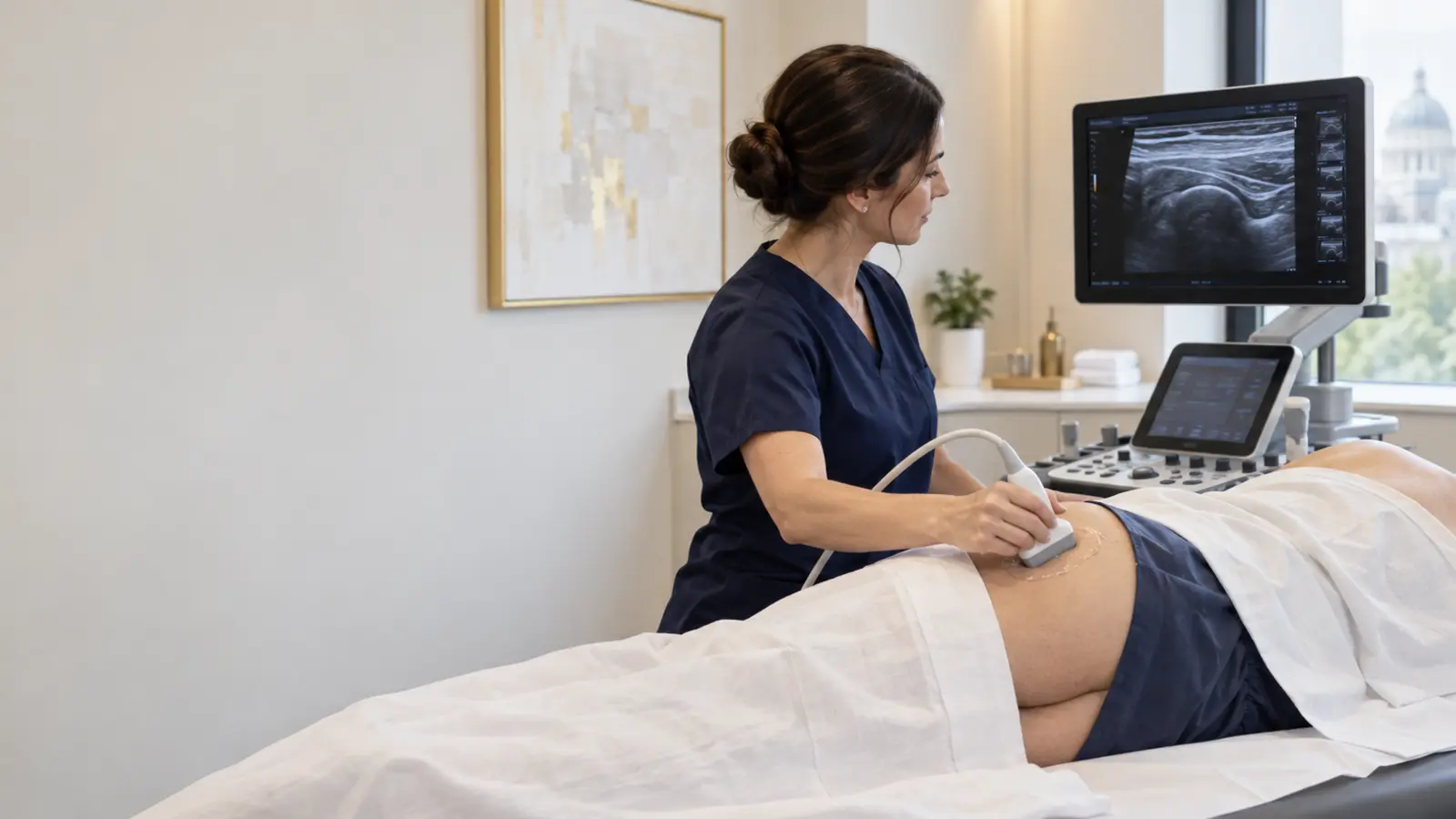
It is painless, with no needles and nothing internal. Warm gel is applied and the clinician moves a small probe over the front, sides and back of the knee. You will be asked to bend, straighten and gently load the knee so the tendons and ligaments can be watched moving. If a movement is uncomfortable, the clinician will adapt.
Can the scan guide a knee injection?
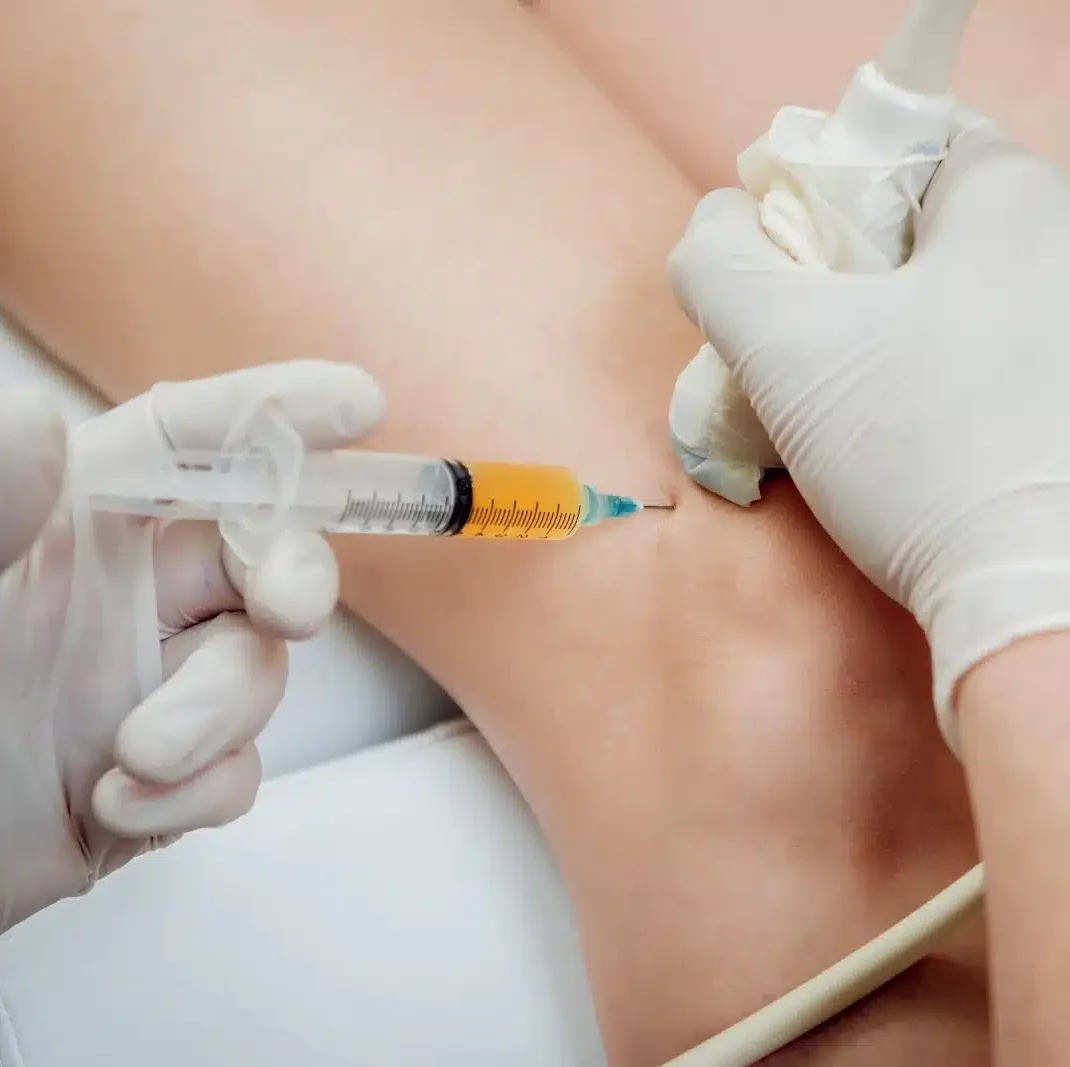
Yes. If the scan confirms a treatable problem such as bursitis, tendinopathy, a Baker’s cyst or fluid in the joint, an ultrasound-guided knee injection or aspiration can often be arranged. Live ultrasound places the needle exactly where it is needed. Treatment is booked and charged separately from the scan.
Does the NHS do a knee ultrasound?
Yes, but usually only after a GP referral and often after a period of physiotherapy, with a wait for the appointment and then the report. A private knee ultrasound gives you a specialist answer, often the same or next day, with results explained in the room and a report you can share with your GP, physiotherapist or surgeon.
Do I need a GP referral for a private knee ultrasound in London?
No. You can book directly online, by phone on 020 7101 3377 or on WhatsApp, with same-day and next-day appointments often available at both clinics. Bring any previous X-ray, ultrasound or MRI reports so the clinician can read today’s findings in context.
Can you scan a child’s knee?
Ultrasound is radiation-free and can be suitable for children in the right circumstances, for example after a sports injury or for a problem such as Osgood-Schlatter. Online booking is for patients aged 18 and over, so please call 020 7101 3377 first so we can confirm suitability and arrange the right appointment.
Do you do a knee ultrasound near me in London?
Yes. Our Central London clinic is at 27 Welbeck Street, W1G 8EN, in the Harley Street Medical District, a short walk from Bond Street, Oxford Circus and Marylebone. Our St Albans clinic is at 54–56 Victoria Street, AL1 3HZ, serving Hertfordshire and North London. Both offer the same knee scan, £199 for one knee and £299 for both, 7 days a week from 9am to 7pm.
Medical disclaimer. This page is general information and does not replace individual medical advice. Some structures, such as the cruciate ligaments, the central meniscus, cartilage and bone, are better assessed on MRI. Go to A&E if your knee pain follows a significant injury with deformity, if you cannot bear weight or straighten the knee at all, or if you have a hot, red, swollen joint with fever or a painful, swollen calf, which can signal a clot.