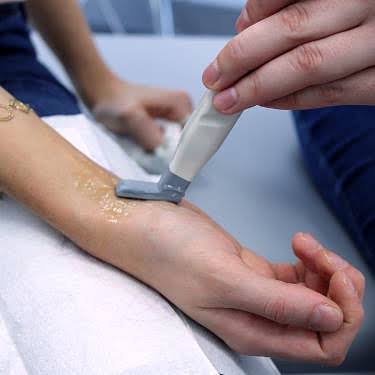
De Quervain’s tenosynovitis: Yes. Ultrasound is the first-line investigation for De Quervain’s. It identifies thickening and fluid within the first extensor compartment tendon sheath (containing the APL and EPB tendons at the radial styloid), confirms the diagnosis, and guides corticosteroid injection directly into the tendon sheath — dramatically improving accuracy compared to palpation-guided injection.
Trigger finger: Yes. Ultrasound detects A1 pulley thickening, a nodule on the flexor tendon, and fluid within the tendon sheath — the structural correlates of triggering. Dynamic assessment during active finger flexion and extension directly demonstrates the snapping phenomenon in real time. Ultrasound-guided A1 pulley injection is significantly more accurate than blind injection.
Jeyapalan K, Choudhary S. Ultrasound-guided injection for De Quervain’s disease. Skeletal Radiol 2009;38:1099–103. | Serafini G et al. High-resolution sonography of the flexor tendons in trigger fingers. J Ultrasound Med 2996;15:213–9.